
The requirement sits in a ticket. The policies live in a wiki or in someone's head, so the next chat starts without them.
An enterprise agentic engineering platform for your team.
From requirements to production-ready artifacts, connect your AI coding tools to a governed software delivery workflow.
Cursor and Claude are tools your engineers use. ScoptX is the engineering system around those tools — delivered with your repository, your standards, and your pipeline.
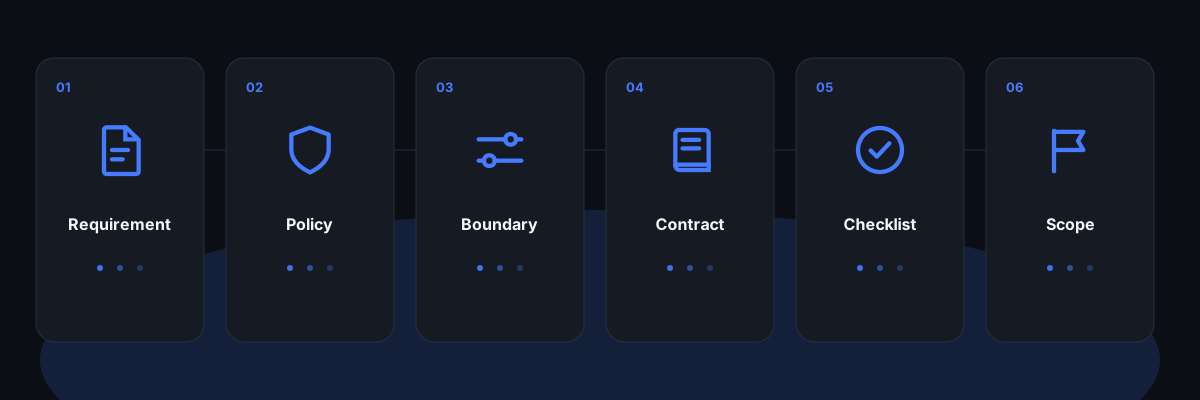
This step sets the requirement and the policies that bound it, before any code is written. The agent has a boundary to work inside.
The requirement sits in a ticket. The policies live in a wiki or in someone's head, so the next chat starts without them.
The requirement and the policies that bound it are the start of the path. The agent begins from those foundations, not from a blank prompt.
Your engineers. Their favorite tools. Supercharged by ScoptX.
No disruption. No relearning. Just the power to build faster, smarter, and more securely.
 Works well with Cursor IDE.
 Works well with Claude.
 The frontend can stay React.
 The frontend can stay Angular.
 The frontend can stay Solid.
 The service can stay Node.js.
 Ships code which is Docker-deployable from day 1.
 Semgrep findings stay with the change.
 The release runs through Jenkins.
 The package runs on Linux.
An agent can draft the change. The organization still has to trust the architecture, the tests, the review, and the release.
Each chat starts from memory. The standards live in people’s heads, so the next run does not inherit them.
Generated code follows the prompt. The conventions the next team has to maintain are easy to miss.
A diff can look finished while the user path, the API contract, and the untested surface stay unclear.
Security comments and approvals sit outside the change, so the evidence does not travel with it.
Source, migrations, generated clients, and the build are assembled by hand when someone is ready to ship.
Foundations, the workflow, the checks, and a package. The agent starts from your standards, and the release leaves with the evidence.
Reusable architecture, project conventions, API contracts, templates, and starter modules so agents begin from your engineering standards.
Coordinate Cursor, Claude, or the IDE you choose through defined tasks, repository context, validation steps, and engineering checkpoints.
SAST, dependency and image scanning, approved patterns, and human review before a change enters the delivery pipeline.
Unit, integration, API, and browser tests, with evidence of what was verified and what remains untested.
Source changes, migration scripts, generated clients, tests, and container images, packaged for Linux or Windows.
Traceability from the requirement and the code change through test results, approvals, and the release record.
The framework and the suite belong to the enterprise. They live in your repository and your pipeline. Scopt stays on for maintenance, ad hoc development, and rolling patches.
The suite is not a seat you rent. Your teams run it in the environment you already trust, and the next change starts from that foundation.
Each time the tool moves, a dedicated upgrade is applied to the code you already own. Security fixes travel with that upgrade. They do not wait for a later project.
Scopt improves the suite and ships that improvement into your environment. Maintenance and ad hoc work follow the same path, so the next request does not start from a blank page.
Choose the stack the team already runs. The last step shows the package this engagement is prepared to deliver.
The stack beside this is the one the team already runs. ScoptX does not replace it. A customer-management module is the first piece of work on that path: access, the contract, and the checks travel with the change. The engagement hands over one package a reviewer can accept, and the next change follows the same path.
Cursor VS Code
 JetBrainsClaudeReactAngularSolid
 Next.js
 TypeScript
 shadcn
 Bootstrap
 Tailwind
 Foundation
 Custom Storybook
 BulmaNode.js
 Express.js
 FastAPI
 Django
 Laravel
 PostgreSQL
 Neo4j
 MySQL
 Oracle Database
 Redshift
 OpenSearch
 Snowflake
 Microsoft SQL
 Databricks
 Git
 GitHub
 GitLab
 Bitbucket
 Forgejo
 OpenAPIOrval
 Bruno
 Playwright
 CypressSemgrepSAST
 TrivySELinux
 OWASP
 ZAPCode ScanDockerLinux
 WindowsJenkins
 Google Cloud
 AWSAWS Serverless
 Azure
 Alibaba Cloud
 Grafana
 Loki
 Prometheus
 OpenTelemetry
 Wazuh
 Bugsink
 Sentry
 PagerDutyCloudWatchX-RayAzure MonitorApplication Insights
 Pulumi
 Terraform
 SonarQube
 CodeRabbit
 Superset
 Airflow
 LangChain
 LangGraph
 Keycloak
 Microsoft Identity
 Okta
 Google Sign-InGitHub Sign-In
 Custom SSO
 Twilio
 WhatsApp
 Telegram
Controlled workflows, traceable changes, security validation, and a release record. The practice can align with ISO/IEC 27001. Certification stays with your management system.
ISO/IEC 27001:2022 is a standard for an information security management system. ScoptX can support the engineering controls and the evidence. Certification stays with the customer’s own management system.
Model and provider access policy, and a clear boundary for what source leaves the environment.
Approved templates, conventions, and contract validation before the change is called done.
SAST with Semgrep on the change, and Trivy scans of dependencies and container images.
Repository permissions, protected branches, and approval gates.
Quality gates and a controlled path into CI/CD.
Requirements, commits, reviews, test results, and releases linked as one record.
Linux or Windows deployment, including SELinux when the host requires it, with documented network placement and data residency.
An engagement can be reviewed against ISO/IEC 27001 and Cert-In. Certification stays with the customer.
The engagement supports an ISO/IEC 27001-aligned engineering practice: controlled workflows, traceable changes, security validation, and a release record. Certification stays with the customer’s own management system.
The same path can be reviewed against Cert-In direction for the customer’s environment. ScoptX does not issue that certification.
The IDE, the frontend and its UI library, the backend, and the database are selected for the engagement. Identity, channels, and the agent framework are included when the engagement uses them. Monitoring, cloud, and the add-ons follow the platforms the team already operates.
CursorVS CodeJetBrainsClaudeClaude OpenRouter
 vLLMReactAngularSolidNext.jsTypeScriptshadcnBootstrapTailwindFoundationCustom StorybookBulmaNode.jsExpress.jsFastAPIDjangoLaravelPostgreSQLNeo4jMySQLOracle DatabaseRedshiftOpenSearchSnowflakeMicrosoft SQLDatabricksGitGitHubGitLabBitbucketForgejoOracle IntegrationOpenAPI 3OrvalBrunoPlaywrightCypressSemgrepSASTTrivySELinuxOWASPZAPCode ScanJenkinsDockerLinuxWindowsGoogle CloudAWSAWS ServerlessAzureAlibaba CloudGrafanaLokiPrometheusOpenTelemetryWazuhBugsinkSentryPagerDutyCloudWatchX-RayAzure MonitorApplication InsightsPulumiTerraformSonarQubeCodeRabbitSupersetAirflowLangChainLangGraphKeycloakMicrosoft IdentityOktaGoogle Sign-InGitHub Sign-InCustom SSOTwilioWhatsAppTelegram
 SplunkMicrosoft Sentinel
 ElasticQRadar
 Chronicle
 Cortex XSOAR
React, Angular, Solid, Node.js, FastAPI, Django, Laravel, the data layer, Oracle, and Jenkins are in the suite. Each engagement starts from the problem the team is closing.
A new module has to match the system already in production. Foundations keep the agent inside that shape.
Oracle and the systems beside it need a contract that survives the next change, not a one-off mapping.
Brownfield React, Angular, Node.js, Python, PHP, and integration work — the repositories that already exist, not only a greenfield app.
Standards that more than one team can execute: templates, API rules, and the path a change has to walk.
Tests written into the workflow, with a record of what ran, what passed, and what was left untested.
A pilot measures these on the customer’s workflow.
From an approved requirement to a reviewable package.
Changes sent back because the standard or the contract was missed.
Time reviewers spend reconstructing what the agent did.
What was exercised, and what the record still leaves open.
Whether the package can enter the pipeline the customer already trusts.
Four records leave with the change. A reviewer can accept the work without reconstructing what the agent did.
The change itself, in the repository, written against the requirement.
What ran, what passed, and what is still open.
The scans, the contract check, and the build for this change.
The approval, and the handoff into the pipeline you already trust.
Traditional delivery, an unrestricted agent, or a suite the enterprise owns. Same work. A different life after go-live.
People carry spec, code, test, and release as separate jobs.
How It Runs
An agent writes fast, with no suite and no fence around the change.
How It Runs
Your IDE and your model, inside a suite the enterprise owns.
How It Runs
An enterprise agentic engineering platform. Your AI writes the code. ScoptX puts that change on a path a reviewer can accept: the requirement, the stack you already run, the checks, the approval, and the release.
No. Cursor, Claude, and the IDE the team chooses stay in place. ScoptX is the engineering system around those tools, delivered with your repository, your standards, and your pipeline.
No. It is a configurable accelerator placed in the customer’s engineering environment. The code, the tests, and the release stay in that environment.
Source changes, test results, build evidence, and the release handoff. The next change follows the same path.
The IDE, the frontend, the backend, and the database are chosen for the engagement. The UI library, and every row after the database, can be omitted when the engagement does not use them.
No. An engagement can support an ISO/IEC 27001-aligned engineering practice, and it can be reviewed against Cert-In direction. Certification stays with the customer’s own management system.
Linux or Windows, through the CI/CD the customer already trusts. That includes self-host and intranet when that is the environment.
The enterprise does. The framework and the suite stay in your repository and your pipeline. Scopt supports maintenance, ad hoc development, and rolling patches. We improve the tool and upgrade the code you already own.
Through security upstream. Each time the suite moves, a dedicated upgrade passes over the code in your environment. The fix is part of that upgrade, not a separate cleanup later.
One engineering challenge from your backlog. Discovery covers the agents, the stack, the conventions, the security boundary, and the pipeline. The pilot states what is packaged, what is integrated, and what is still on the roadmap.
Bring one workflow from the backlog. We prove the path on your agents, your stack, and your pipeline. After that, you own the suite, and Scopt stays on it.